SEOLREIM · JOURNAL
Temple filler effects and risks: checklist for vascular occlusion and vision-damage prevention
Full translation of the Korean article. Translation checked for completeness, numerical consistency and medical meaning; separate medical review of this translation is pending. Translation updated: 2026-10-28.

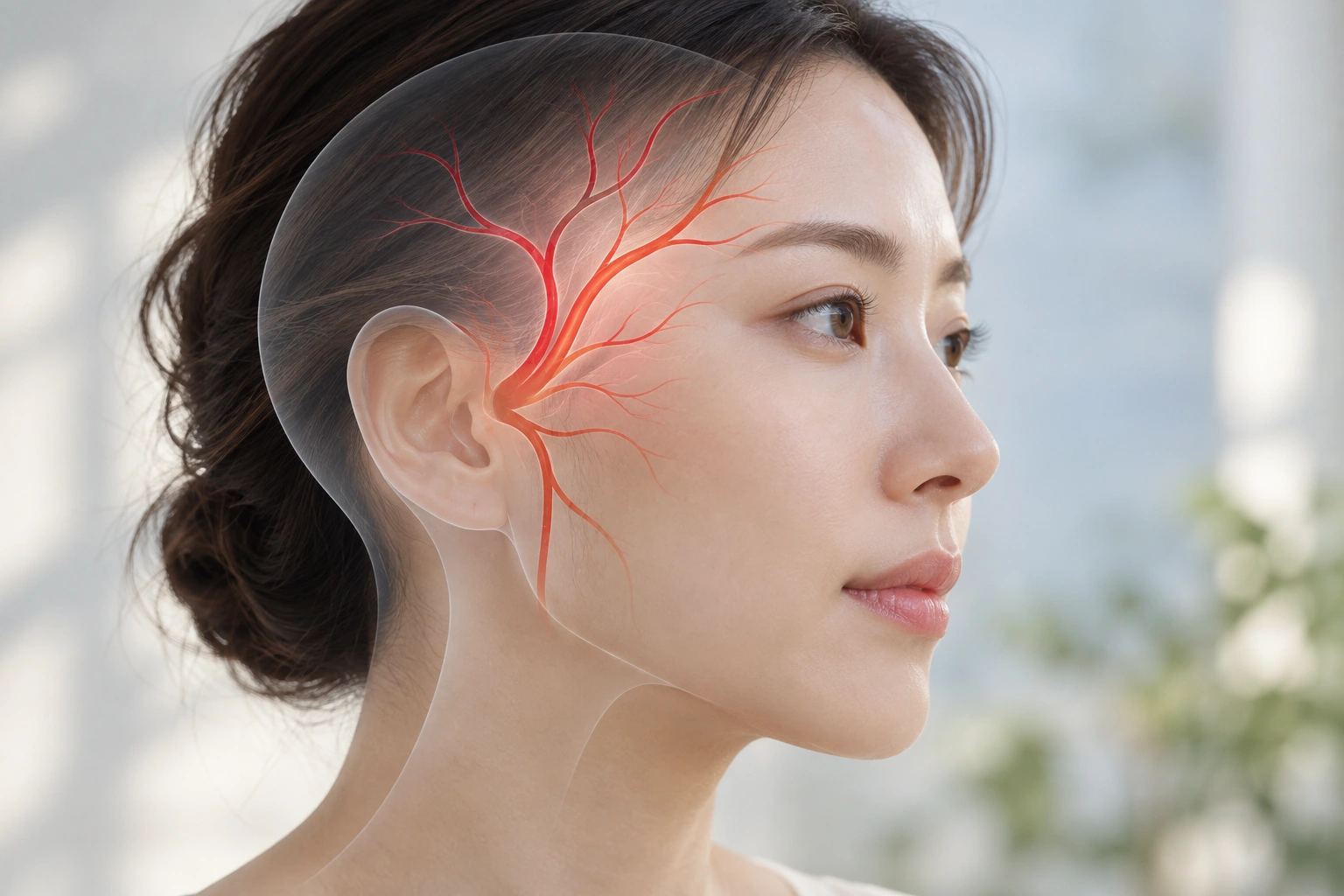
Temple filler replaces volume in temporal hollows to smooth facial-contour transitions. However, the area contains multiple vessels and nerves and routes to the eye circulation, creating rare risks of vascular occlusion, skin necrosis and vision damage. Safety depends on combined anatomical assessment, low-volume, low-pressure injection, product verification and emergency response, rather than a single instrument or the claim “a cannula is always safe”.
Definition, benefits and precautions at a glance
| Category | What to check |
|---|---|
| Goal | Limited volume replacement in temple hollows and contour transitions |
| Limitations | Does not correct all skeletal, muscle or skin-sagging issues |
| Common reactions | Swelling, bruising, tenderness, and temporary asymmetry |
| Serious risks | Vascular occlusion, skin necrosis, visual abnormalities and rare cerebrovascular complications |
| Emergency signs | Severe pain, pale/blue skin, mottling and blurred/double vision |
Definitions and how the treatments work
The temple contains overlapping skin, fascia, fat, muscle and periosteal layers and superficial and deep temporal vessels. Even within the “temple”, injection planes differ and individual vascular variations exist; photographs or finger palpation cannot eliminate risk. HA filler breakdown may be attempted with hyaluronidase if needed, but this does not prevent vascular occlusion. CaHA, PLLA and fat do not dissolve in the same way.
Potential benefits and limitations
In appropriate candidates, treatment may reduce shadows from hollowing and improve the forehead–cheekbone transition. But volume loss associated with chewing-muscle atrophy, weight changes, skeletal structure or brow sagging is not solved by filler alone. A 2025 anatomical study described possible routes from deep temporal arteries to the ophthalmic artery, not proof that a particular technique completely eliminates risk.
Suitable candidates and preliminary assessment
Adults mainly concerned about temple hollows may consult. Report previous temple, forehead or cheekbone fillers, fat grafting, thread lifts, facial surgery, migraine, vision disorders, medicines increasing bleeding risk, infections, dental treatment, autoimmune disease and allergies. Unknown existing injectables or recurrent swelling and nodules require composition and location assessment before new filler.
Procedure, recovery and preparation
Assess asymmetry, temporal muscles, vascular pulsation, skeletal structure and brow position from frontal and oblique views; obtain explanations of product, total amount, injection plane and instrument. Ultrasound may help identify vessels and prior filler in some complex cases, but does not eliminate all vascular risks. Bruising and swelling can last several days or longer; avoid treatment just before important photographs or flights and secure emergency contact.
Adverse effects, contraindications and precautions
Common reactions include bruising, swelling, tenderness and temporary unevenness. Infection, nodules, overcorrection, migration or temporal-muscle discomfort may occur. Rare intravascular entry can cause skin necrosis, retinal blood-flow obstruction, vision damage or stroke. Extreme pain, pallor or blue changes, blurred or double vision, eyelid droop or severe headache during or immediately after treatment need immediate emergency response.
Differences between HA, CaHA, PLLA and fat grafting
| Method | Main goal | Key differences and precautions |
|---|---|---|
| HA fillers | Immediate volume; elasticity and duration vary by product | Vascular occlusion risk; enzymatic breakdown may be attempted if needed |
| CaHA filler | Volume and collagen-response goals | Does not dissolve with hyaluronidase like HA |
| PLLA | Collagen stimulation over time | Not an immediately finished result; consider nodules, dilution and injection technique |
| Autologous fat | Surgical harvesting and injection | Variable resorption, calcification, vascular complications and surgical recovery |
Questions and answers for a medical consultation
The answers below are literature-based consultation questions, not a clinician interview or individual diagnosis; actual medical review remains incomplete.
Q. Does a cannula prevent vascular occlusion?
A. It may be a risk-reducing option, but does not make the possibility of vessel entry 0.
Q. Does using ultrasound make it completely safe?
A. It may help identify vessels and existing filler, but resolution, operator and timing limitations mean it does not replace emergency response.
Q. Can I wait out a headache after treatment?
A. Unlike mild pressure, headache accompanied by visual changes, severe pain or neurological symptoms needs immediate assessment.
Evidence sources and full text
2025 anatomical study of ophthalmic artery occlusion routes in temple filler (https://pubmed.ncbi.nlm.nih.gov/39749811/), anatomy-based temple filler guide (https://pmc.ncbi.nlm.nih.gov/articles/PMC11856534/), FDA Dermal Fillers risk information (https://www.fda.gov/medical-devices/aesthetic-cosmetic-devices/dermal-fillers-soft-tissue-fillers), review of filler-related vision damage (https://pmc.ncbi.nlm.nih.gov/articles/PMC8294333/) were consulted. Evidence checked on 2026-10-03.
SEOLREIM’s principle of consultations and procedures performed personally by the director
SEOLREIM Clinic describes its principles of consultations and procedures performed personally by the clinic director, genuine products, appropriate quantities and attentive care. Consultation starts by distinguishing skin condition and goals, then checking the products and equipment actually available, approved uses, the dose or energy plan, recovery and risks. For temple filler, the clinic director personally assesses whole-face volume, brow–cheekbone transitions and prior injectables. Confirm the actual product, amount, ultrasound availability, emergency protocols and signature anti-aging combinations at examination.
Booking, language, and location information for overseas visitors
Visitors seeking temple filler in Korea or cosmetic dermatology in Seoul should ask before booking about the product, total amount, emergency response, contacts for visual symptoms and time for review before departure. SEOLREIM Clinic is approximately 1 minute from Exit 3 of Gangnam Station, on the 11th floor of the Gangnam 8258 Building. You can book through the website’s KakaoTalk consultation, Naver booking or telephone channels. Overseas visitors comparing dermatology clinics in Gangnam, Seoul, the Gangnam Station area or Korea should prepare details of medications, allergies, recent procedures and departure dates. When booking, state your preferred language, such as Japanese, Chinese, Arabic, Mongolian or Indonesian, and whether you need an interpreter, to confirm the actual scope and cost of support. Continuous consultation availability in each language and same-day procedures cannot be confirmed. Also agree on contact arrangements for adverse reactions after returning home and the follow-up schedule during consultation.
Authorship, review and dates
Author: SEOLREIM content editor / Medical-professional review: completed / Review confirmed: 2026-10-23 / Published: 2026-10-03 / Updated: 2026-10-27. This is general medical information and does not replace individual diagnosis or a procedural prescription.
SEOLREIM · GANGNAM, SEOUL
Discuss Skin Treatments in Seoul with Seolreim Clinic.
SEOLREIM Clinic provides consultations and procedures personally performed by the clinic director, following its principles of genuine products, appropriate quantities and attentive care.
Tell us your treatment interests, skin concerns, dates in Korea and preferred consultation language. Confirm treatment suitability, recovery plans and language support before booking.