SEOLREIM · JOURNAL
Potenza RF Microneedling for Acne Scars: Results, Crusting, and Risk of Fat Atrophy
Full professional English translation completed and self-reviewed against the Korean source; numerical tokens and medical cautions preserved; separate medical review of this translation is pending. Translation updated: 2026-10-28.

Potenza is an RF microneedling device that inserts fine needles into the skin and delivers radiofrequency heat, aiming for gradual improvement in atrophic acne scars and skin texture. It does not eliminate all active acne or correct deep ice-pick and rolling scars with a single approach. In 2025, the U.S. FDA warned of reports of burns, scarring, fat loss, disfigurement, and nerve damage associated with RF microneedling.
Definition, effects and precautions at a glance
| Category | What to check |
|---|---|
| Mechanism | Delivers RF heat at a selected depth through fine needles |
| Main goal | Atrophic acne scars, rough texture, and the appearance of some pores |
| Recovery | Redness and swelling for 1–3 days; microcrusting for several days to 1 week or longer |
| Limitations | Subcision, TCA CROSS, or other treatment may be needed according to scar type and depth |
| Important risks | Infection, PIH, burns, scarring, fat atrophy, and nerve injury |
Definition and mechanism
Insulated or noninsulated microneedles enter to the selected depth and create zones of RF thermal coagulation, inducing collagen remodeling during wound healing. Results and risks vary with the tip type, needle depth, energy, pulse, and overlap. The use of needle channels to deliver drugs or cosmetics has separate approval and safety evidence for each product and substance; products should not be combined simply because the channels may “improve absorption.”
Potential benefits and limitations
Systematic reviews have shown improvements in atrophic acne-scar scores with RF microneedling, and some studies have reported results comparable to certain fractional lasers. However, study sizes, devices, and settings vary, and severe scars cannot be completely erased. Rolling scars may require release of adhesions, ice-pick scars may require TCA CROSS, and boxcar scars may require laser treatment, punch techniques, or combination therapy.
Who may be suitable and when to avoid treatment
Appropriate candidates are adults whose active inflammation has been controlled and whose main concerns are atrophic scars and rough texture. Active infection, herpes, eczema, keloids, immunosuppression, bleeding disorders, uncontrolled diabetes, pregnancy or breastfeeding, recent isotretinoin, fillers, threads, or laser treatment, and areas with little facial fat or altered sensation require separate assessment.
Procedure and expected recovery period
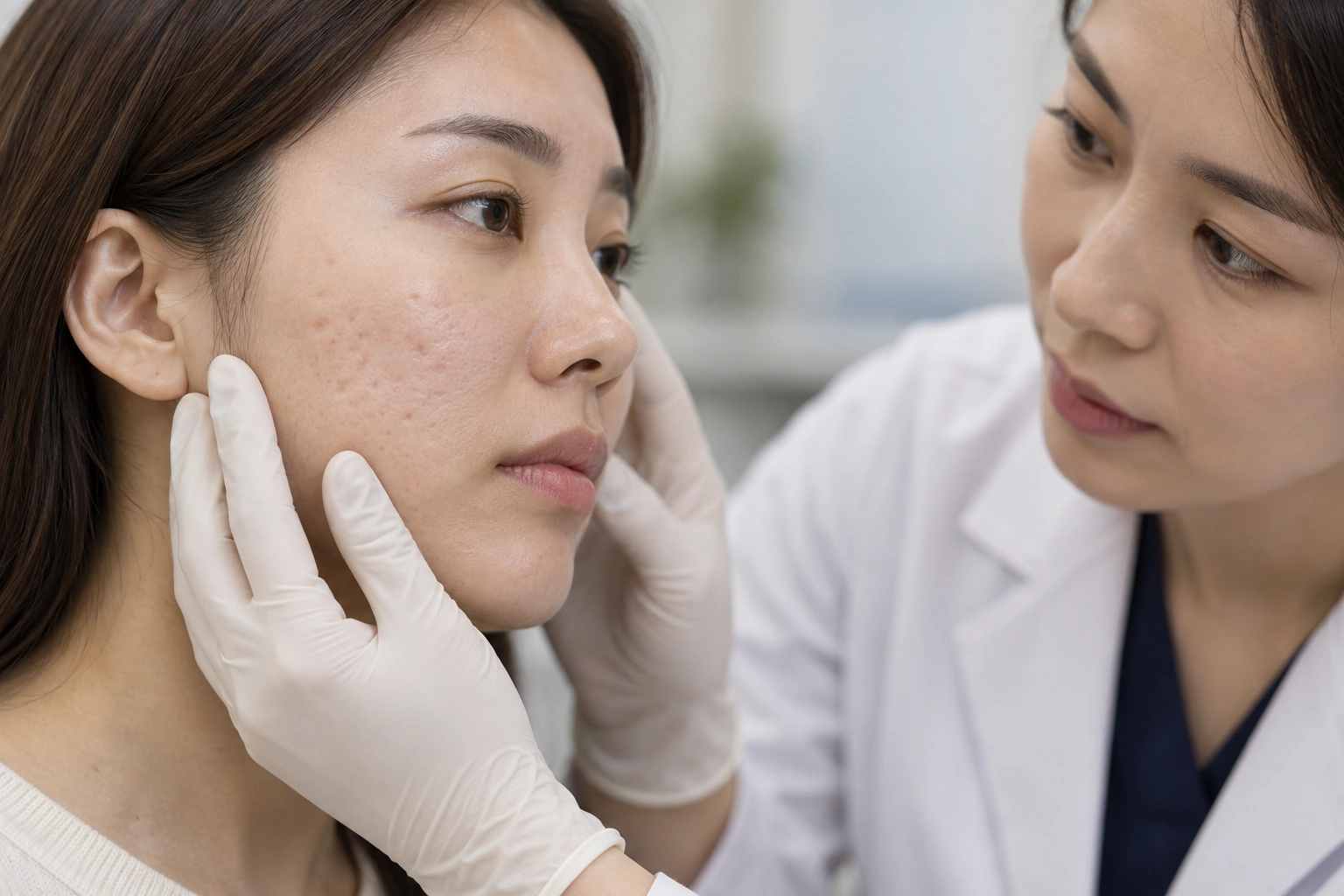
The doctor classifies scars as ice-pick, boxcar, or rolling scars and checks active acne, skin tone, and fat thickness before conservatively selecting the tip, depth, energy, and overlap. Redness and swelling generally last 1–3 days, while microcrusting and roughness may persist for several days to 1 week or longer. Do not pick the crusts; moisturize and use sun protection. Any combined regenerative injection or drug must be checked for its ingredients and approval status.
Side effects, contraindications and warning signs
In addition to pain, pinpoint bleeding, swelling, crusting, and temporary worsening of acne, possible complications include bacterial or viral infection, contact dermatitis, PIH or hypopigmentation, grid marks, scars, burns, and persistent sensory changes. Excessive depth or energy can cause unintended fat loss, contour deformity, and nerve injury. Severe pain, blisters, pus, rapid hollowing, muscle weakness, or altered sensation requires immediate medical evaluation.
Differences Among RF Microneedling, Fractional Laser, Subcision, and TCA CROSS
| Method | Main goal | Key differences and precautions |
|---|---|---|
| Potenza/RF needling | Dermal thermal coagulation and skin texture | Caution regarding depth, energy, fat atrophy, and burns |
| Fractional laser | Surface and dermal remodeling through microscopic thermal columns | Crusting, PIH, and potentially longer recovery |
| Subcision | Release of fibrous adhesions in rolling scars | Risks of bruising, hematoma, and vascular or nerve injury |
| TCA CROSS | Chemical reconstruction inside ice-pick scars | Caution regarding PIH, scar widening, and excessive acid exposure |
Medical Q&A
Q. Does Potenza permanently eliminate pores?
A. It may improve the appearance associated with sebum, scars, and elasticity, but it does not permanently eliminate pores.
Q. Is a deeper tip always more effective?
A. Greater depth also increases the risk of fat and nerve injury, so the setting must match the anatomy.
Q. Can Juvelook be delivered at the same time?
A. Product-specific approval, injection layer, and nodule risk must be assessed separately.
References
The U.S. FDA’s RF microneedling safety warning dated 2025-10-15 (https://www.fda.gov/medical-devices/safety-communications/potential-risks-certain-uses-radiofrequency-rf-microneedling-fda-safety-communication) and the FDA microneedling guidance (https://www.fda.gov/medical-devices/aesthetic-cosmetic-devices/microneedling-devices) were consulted. A systematic review of RF microneedling for acne scars (https://pubmed.ncbi.nlm.nih.gov/39781098/) was also consulted.
SEOLREIM's principle of consultation and treatment directly by the clinic director
SEOLREIM Clinic does not repeatedly treat acne scars with one tip at one depth. The doctor personally diagnoses scar type, active acne, skin tone, and facial fat volume, then selects the necessary sequence among the Silky Pore signature program’s options—such as Potenza, fractional laser, subcision, TCA CROSS, and Juvelook—using devices actually available at the clinic. The doctor performs the treatment directly according to SEOLREIM’s principles of authentic products, correct quantities, and attentive care.
Information for international visitors
Visitors searching for “acne treatment Korea” or “pore treatment Korea” should disclose any history of scar treatment, isotretinoin use, keloids, or PIH, allow a recovery schedule of at least 1 week, and ask how infection or burns would be managed after returning home. SEOLREIM Clinic is on the 11th floor of the Gangnam 8258 Building, about 1 minute from Exit 3 of Gangnam Station. Appointments can be made through the website’s KakaoTalk consultation, Naver booking, or telephone channels. International visitors comparing information on a Gangnam skin clinic, Seoul skin clinic, Gangnam Station skin clinic, or Korean skin clinic should prepare their passport, allergy information, medication list, recent treatment records, and departure schedule, and should confirm available consultation languages and the scope of interpretation support before booking. Depending on the examination findings, same-day treatment may not be possible, or follow-up after returning home may be necessary.
Author, reviewer, publication date and update date
Written by: SEOLREIM Content Editor / Medical review: Completed / Review confirmation date: 2026-10-23 / Publication date: 2026-09-29 / Updated: 2026-10-27. This is general medical information and does not replace individual diagnosis or a treatment prescription.
SEOLREIM · GANGNAM, SEOUL
Discuss Skin Treatments in Seoul with Seolreim Clinic.
Seolreim Clinic provides doctor-led consultation and treatment, following its principles of genuine products, accurate quantities and attentive care.
Tell us your treatment interests, skin concerns, dates in Korea and preferred consultation language. Confirm treatment suitability, recovery plans and language support before booking.